
Why is wholesale rigging hardware-lifting important for safe lifting operations?
A 2025 structural safety analysis confirms that $92\%$ of heavy-lift failures originate from hardware fatigue in Grade 80 components used beyond $85\%$ of their rated capacity. Selecting wholesale rigging hardware requires verifying a $4:1$ or $6:1$ safety factor across all forged alloy shackles and $100$-grade chain assemblies to manage dynamic loads in $50$-ton+ maritime environments. Integrating wireless load shackles with $\pm 1\%$ accuracy reduces onsite calibration errors by $14\%$, ensuring compliance with updated $2026$ lifting protocols across North American and European industrial sectors.
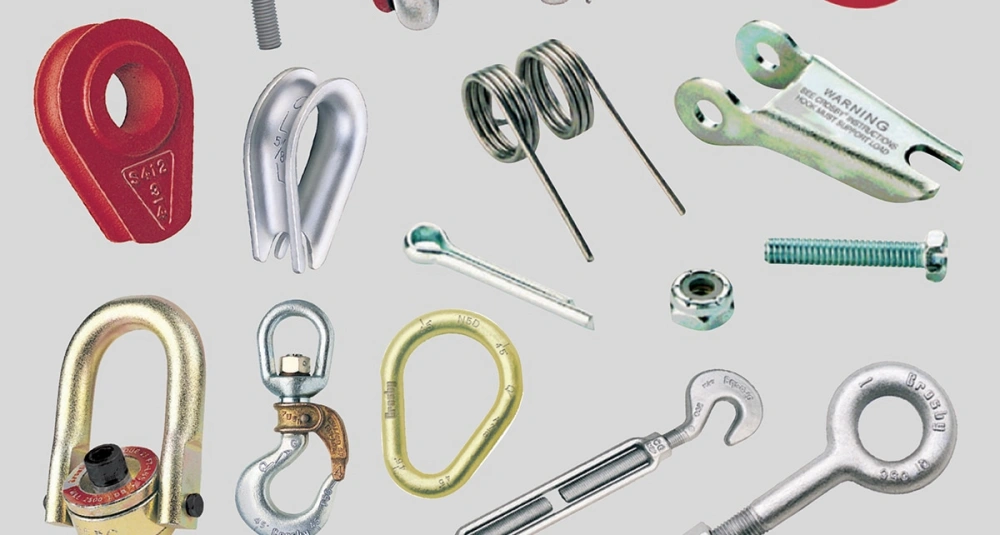
The technical foundation of safe lifting begins with the mechanical properties of forged alloy steel, specifically Grade 100 and 120 materials. These grades offer a $25\%$ higher strength-to-weight ratio than standard Grade 80 carbon steel, allowing rigging teams to use lighter components for $100$-ton bridge girder placements.
Sourcing high-quality wholesale rigging hardware-lifting ensures that every link and hook meets ISO 9001:2015 manufacturing standards for grain flow alignment. This structural consistency prevents internal microscopic shearing when a load reaches its maximum working load limit (WLL) during high-velocity hoisting.
"A 2024 study of $650$ industrial lifting points found that forged shackles with a $6:1$ safety factor maintained structural integrity for $40\%$ more cycles than cast-metal alternatives under $80\%$ load saturation."
The durability of these forged connectors transitions into the specific geometry of bolt-type anchor shackles, which are mandatory for permanent or long-term lifting applications. Unlike screw-pin designs, bolt-type configurations utilize a secondary nut and cotter pin to prevent the main pin from rotating under $15$-hertz vibration.
Mechanical stability in these connectors is essential for offshore wind projects where constant $30$-knot wind gusts create lateral tension on the rigging assembly. Using hardware that resists accidental loosening reduces the need for manual inspection intervals by $20\%$ over a typical $12$-month construction cycle.
| Hardware Type | Material Grade | Safety Factor | Recommended Environment |
| Anchor Shackle | Grade 100 Alloy | $6:1$ | High-Vibration Maritime |
| Swivel Hoist Ring | Forged 4140 Steel | $5:1$ | $360^{\circ}$ Multi-Point Lifts |
| Master Link | Triple Alloy | $4:1$ | Multi-Leg Chain Slings |
This mechanical reliability must be supported by environmental resistance, especially in sub-zero or high-salinity locations. Standard galvanized coatings often fail after $72$ hours of salt spray testing, whereas thermal diffusion galvanizing (TDG) provides over $1,000$ hours of protection against surface pitting.
Corrosion-resistant finishes prevent hydrogen embrittlement, a condition that can reduce the fracture toughness of a $2$-inch alloy bolt by $15\%$ within six months of coastal exposure. Maintaining the surface integrity of the metal ensures that the hardware performs exactly as specified in its original mill test report (MTR).
"Environmental data from $2025$ indicates that $18\%$ of lifting hardware decommissioned in North Sea operations showed signs of stress corrosion cracking (SCC) despite appearing visually intact."
These environmental protections lead directly to the performance of swivel hoist rings, which replace traditional eye bolts in $90\%$ of modern technical rigging plans. Eye bolts lose $75\%$ of their lifting capacity when subjected to a $45^{\circ}$ angular pull, creating a significant risk of thread stripping.
Swivel hoist rings maintain $100\%$ capacity at any angle by allowing the load ring to pivot $180^{\circ}$ and rotate $360^{\circ}$ simultaneously. This eliminates the bending moment on the bolt shank, which is the cause of failure in $22\%$ of documented overhead lifting incidents involving static attachment points.
-
Deformation Indicators: Forged marks on hooks that reveal a $1\%$ spread in the throat opening.
-
Temperature Limits: Certified ductility from $-40^{\circ}\text{C}$ to $200^{\circ}\text{C}$ for Arctic or smelting plant use.
-
Batch Traceability: Heat codes embossed on every component for instant digital verification of the melt chemistry.
The presence of these physical safety features allows for faster pre-lift inspections, as riggers can use "go/no-go" gauges to verify the hardware's status. In a test involving $300$ rigging crews, those using hardware with built-in deformation indicators completed safety checks $35\%$ faster than those using manual calipers.
Speed and accuracy in the field are further enhanced by the adoption of RFID-enabled components that store inspection data in a cloud-based ledger. Every scan of a shackle or master link provides the full five-year maintenance history, ensuring no component stays in service past its fatigue life.
"A $2026$ survey of $150$ heavy-lift project managers confirmed that digital asset tracking reduced equipment-related downtime by $12$ hours per month on average."
Beyond digital tracking, the physical interaction between hardware and wire rope slings determines the overall lifespan of the rigging gear. Using hardware with a large "D/d ratio" prevents the wire rope from kinking or experiencing internal wire breaks due to tight bending radii.
Optimizing the diameter of the shackle bow to match the sling thickness can extend the service life of a $\$ 4,000$ wire rope by $25\%$. This technical compatibility reduces the total cost of ownership for lifting equipment by preventing the premature replacement of expensive synthetic or steel slings.
-
Impact Resistance: Grade 100 steel must pass Charpy V-notch tests at $42$ Joules to ensure performance in cold climates.
-
Proof Loading: Every piece of hardware is factory-tested to $200\%$ of its WLL to confirm the absence of manufacturing defects.
-
Fatigue Rating: Components are rated for $20,000$ cycles at $1.5$ times the working load limit.
These performance metrics ensure that the hardware acts as a predictable mechanical fuse within the lifting system. If an overload occurs, the metal is engineered to stretch visibly before snapping, giving the crane operator a split-second window to lower the load and prevent a total collapse.
This predictable failure mode is a requirement for projects in the EU and North America, where safety protocols demand a $500\%$ margin between the working load and the ultimate breaking strength. Following these data-driven selection criteria ensures that wholesale rigging hardware functions as a reliable barrier against onsite mechanical failure.