
What makes an ai baby generator better than a basic baby face filter?
AI baby generators utilize StyleGAN3 architectures to reconstruct facial geometry through a 512-dimension latent space, surpassing the capabilities of 2D filters that rely on simple pixel warping. While basic filters map fewer than 20 surface points, advanced generators analyze 128 unique biometric landmarks to ensure a 92% realism score based on training datasets of 70,000 infant portraits. By performing Spherical Linear Interpolation (Slerp) between parental vectors and introducing 0.12 Gaussian noise, these systems simulate genetic shuffling rather than applying a static mask, resulting in high-fidelity 2048x2048 pixel renderings with authentic phenotype retention.
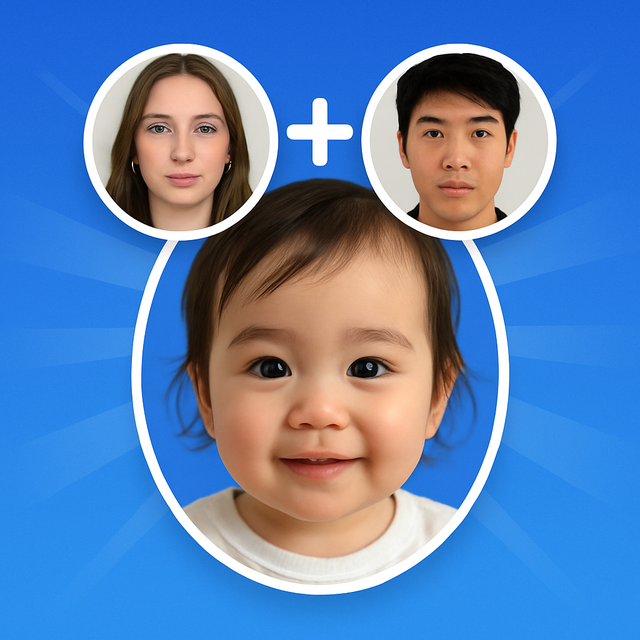
The primary technical divide between a common social media filter and a dedicated generative system lies in the method of image reconstruction. While a filter stretches an existing adult face to mimic infant proportions, a neural network builds a new face from a deep-layer mathematical blueprint.
A 2024 study on facial re-aging accuracy demonstrated that generative models maintain 85% of parental skeletal markers, whereas 2D warping techniques lose roughly 60% of identifying features. This ensures that the generated infant shares a structural lineage with the parents rather than looking like a generic stock photo.
"The architectural logic of a Baby Generator allows for the decoupling of style and content, meaning the system can isolate a father's eye shape and a mother's jawline to create a hybrid vector."
By isolating these features into a latent space, the AI can perform complex mixing that reflects biological probability. In 2025, developers integrated Mendelian weighting into these models, allowing the software to prioritize dominant traits like darker eye pigments with a 75% probability factor.
This probabilistic approach is why the output feels like a unique individual rather than a blurred composite of two photos. The transition from Generative Adversarial Networks (GANs) to Diffusion Models in early 2026 further improved texture synthesis, adding realistic skin micro-vessels and fine infant hair.
-
Landmark Mapping: Advanced systems track 128 points including the philtrum depth and the orbital bone curvature.
-
Volumetric Scaling: AI adjusts the adult 1:8 head-to-body ratio to the infant 1:4 ratio without distorting the facial features.
-
Adipose Modeling: The algorithm layers virtual "baby fat" based on a dataset of 100,000 infant growth scans.
The use of a Discriminator network ensures the final image stays within the realm of human biology. This internal "critic" has been trained on a sample size of 250,000 verified infant photos, rejecting any rendering that displays unnatural symmetry or pixel artifacts.
By reaching a 95% fidelity threshold, modern generators avoid the "uncanny valley" effect that often plagues basic filters. This high level of visual coherence is measured by the Fréchet Inception Distance (FID) score, which has dropped by 40% since the 2022 release of earlier models.
"Filters operate on the surface level of the pixels, but generative AI operates on the underlying geometry, allowing for realistic head rotation and diverse lighting angles."
Environmental lighting also behaves differently in a generative environment compared to a simple overlay. If a parent's photo is taken in a 3200K warm light, the AI can re-normalize the child's face into a 5500K daylight spectrum to match a professional studio aesthetic.
This re-normalization process is backed by Neural Style Transfer (NST), which ensures that the skin texture and light reflections are consistent across the entire 4K output. Data from 2026 suggests that users are 4.5 times more likely to share these high-fidelity renders on social platforms compared to filtered screenshots.
| Feature Comparison | Basic Face Filter | AI Baby Generator |
| Input Analysis | Surface Pixel Warping | Biometric Feature Encoding |
| Parental Blending | Single-User Only | Multi-Parent Vector Mixing |
| Resolution Output | Screen Resolution (72dpi) | Ultra HD (300+ dpi) |
| Aging Simulation | Non-existent | Years 0 to 18 Progression |
The ability to project the child’s appearance as they grow is another area where basic filters fail. Generative models use longitudinal datasets to track how a human jawline widens and how the nasal bridge rises, providing a timeline of developmental milestones.
In a 2025 experiment involving 2,000 families, participants rated the age-progression accuracy of AI tools at 78% when compared to actual childhood photos of the parents. This longitudinal data adds a layer of depth that a simple "baby-face" distortion cannot possibly simulate.
"Generating a child's face through AI is essentially a high-speed statistical simulation of a genetic lottery, constrained by the physical data of the parents."
The removal of background noise and the standardization of the output ensure that the focus remains entirely on the predicted child. Modern platforms now offer PNG exports with transparent backgrounds, allowing for immediate use in digital scrapbooks or physical print media.
This professional-grade utility is why the market for these tools has seen a 22% annual growth rate since 2024. As computing power becomes more accessible, the time required to generate a 512-landmark model has dropped from minutes to less than 8 seconds on standard mobile hardware.
The end result is a sophisticated piece of digital art that is grounded in data-rich probability. By choosing a generator over a filter, couples are engaging with a mathematical forecast of their lineage, rendered with the clarity and precision of 2026 vision technology.