
Due Diligence on a Fragrance Partner: A Kids-Safe Line Timeline
Due diligence on a fragrance partner is not an audit you bolt onto the end of sourcing; it is a sequence of decisions that must land before the next stage starts, and on a kids-safe format it takes longer than most first-time buyers expect. The bottleneck is rarely the questionnaire. It is that material restrictions, testing and documentation each need their own window, and those windows sit on the critical path rather than beside it. If you plan the verification steps as a parallel workstream, the project slips by the length of whatever you skipped.
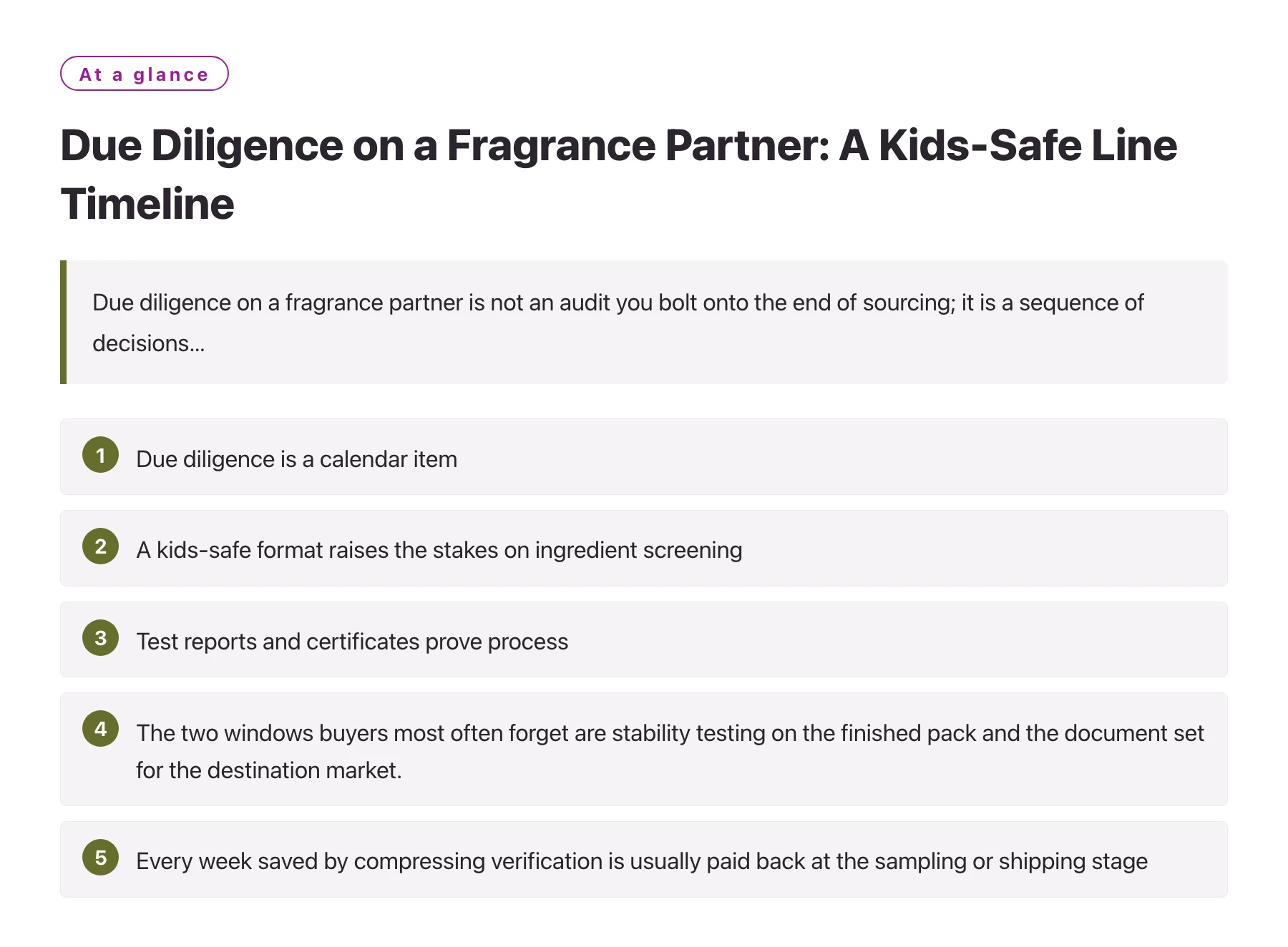
Key takeawaysDue diligence is a calendar item, not a checklist: each verification step has to finish before a specific downstream decision is made. · A kids-safe format raises the stakes on ingredient screening, because fragrance materials are restricted by product category rather than by brand preference. · Test reports and certificates prove process, not fit; the useful question is who performed the test, on what sample, and against which specification. · The two windows buyers most often forget are stability testing on the finished pack and the document set for the destination market. · Every week saved by compressing verification is usually paid back at the sampling or shipping stage, and the second payment is larger.
Buyers who are new to children's or kids-safe fragrance formats tend to treat verification as a formality they complete once a supplier looks credible. Buyers who have launched one before treat it as a fixed sequence with dates attached, because they have watched a launch stall while a test result was still outstanding.
The sequence is not complicated, but it is order-dependent. Ingredient screening constrains the formula. The formula constrains the testing plan. The testing plan constrains the packaging decision, because the pack is part of what gets tested. Documentation comes last but has to be requested first, since certificates and statements take time to issue.
What follows is the order that keeps a kids-safe project moving, with the points where the calendar habitually slips marked in plain terms.
What each piece of evidence actually establishes
| What you request | What it can establish | Where it stops being useful |
|---|---|---|
| Ingredient and allergen declaration for the proposed formula | Whether the materials present are permitted for the intended product category and which allergens have to be declared | It says nothing about the concentration actually used in your batch unless the declaration is issued against your approved formula revision |
| Safety assessment or toxicological review | That someone qualified has considered the formula against the intended use and the population it is aimed at | A generic assessment written for a different category or a different age group does not transfer, even if the wording looks similar |
| Manufacturing certification such as ISO 22716 or GMPC | That a recognised good-manufacturing-practice system is in place and has been audited by a third party | It is evidence about a management system, not about the specific batch you are about to receive |
| Stability and compatibility test results, including any safety testing in perfume manufacturing report the partner runs | How the formula behaves in the actual pack over time, including colour, odour and seal integrity | Results from a different container or closure combination do not apply, because the liner and pump can drive the outcome |
| Retained reference samples and batch records | That the approved standard can be compared against production output later, dispute by dispute | Without a written retention period and a named keeper on both sides, the samples tend to disappear |
Read the table as a chain rather than a menu: each item makes the next one meaningful, and none of them substitutes for the others.
Sequencing verification against the development calendar
The practical way to plan is to work backwards from the shipping date. Sampling needs an approved formula; an approved formula needs ingredient screening; screening needs a brief that states the intended user and the product format. Once you lay those dependencies out, the verification steps stop looking like paperwork and start looking like milestones with owners.
A manufacturer that can run development and production in one place shortens this chain simply by removing handoffs, which is one reason buyers look for custom fragrance development partner arrangements when a category is new to them. It does not remove the verification work, but it removes the weeks that disappear when a formulator, a filler and a testing laboratory are all waiting on each other's paperwork.
Screen the category before you screen the supplier
Fragrance materials are not approved or restricted as a single global list. The standards that govern them set maximum use levels that differ by product type and by how the product is used, and they are revised periodically [1]. For a kids-safe format, that means the first question is not which supplier you trust but which category the product falls into and what that category permits.
This is also why a supplier's existing formulas for adult fine fragrance tell you less than you would like. The same perfumer can build both, but the screening route is different, and the paperwork that supports an adult line will not carry a children's line on its own.
Ask who ran the test, and on what
Third-party laboratories test cosmetic and personal care products for microbiology, stability and packaging compatibility, and those reports are the closest thing to neutral evidence a buyer receives [2]. The trap is accepting a report that is real but irrelevant: it was run two formula revisions ago, or on a stock container rather than your decorated bottle.
The correction is a one-line habit. For every report, write down the formula revision, the container and closure, the date, and the laboratory. If any of those four is missing, the report is a conversation starter rather than evidence.
Build the scientific review into the timeline
In the European Union, the safety of cosmetic ingredients is examined by a standing scientific committee whose opinions feed into the rules that manufacturers work to [3]. You will not commission that work yourself, but knowing it exists changes what you ask for: an assessment that cites the intended use and the population, rather than a sentence confirming the absence of a handful of named substances.
Ask for the assessment at the brief stage, not at the approval stage. It is cheap to change direction early and expensive to change it once tooling and print are committed. If you have not yet chosen the partner who will hold the formula, the same evidence standard applies while you compare candidates, which is what the working method for how to evaluate a custom fragrance manufacturer is for.
Five verification windows and the decision each one unlocks
- Window one: category and use-case definitionBefore any sampling, agree the product format, how it will be applied, and who it is intended for. Everything downstream is screened against this definition, so an ambiguous brief produces an unusable result.
- Window two: material restrictions and allergen listConfirm which materials the category limits and which components have to appear on the label. This decides whether the perfumer's first idea is viable at all.
- Window three: first sample and sensory sign-offApprove the scent on the standard format, in writing, and record the revision. A verbal yes at this stage is the most expensive kind.
- Window four: stability and compatibility on the finished packRun the formula in the real container with the real closure for the real duration. This is the window that most often collides with a launch date, because it cannot be compressed.
- Window five: documentation and market obligationsCollect certificates, declarations, safety documentation and any market-specific paperwork, with named owners and issue dates for each. Request them at window one so they arrive at window five.
The single most useful habit in a kids-safe project is to write the verification plan into the purchase order as dated milestones with named owners on both sides. A supplier's public description of its own process, such as Xuelei, is a starting point for questions rather than a conclusion, and it will tell you which certification language the supplier is comfortable using. What it cannot tell you is whether the specific formula you briefed has been screened for the category you are selling into. Only the milestone list does that.
Sources
- IFRA Standards Library (International Fragrance Association) —— The IFRA Standards Library lists the restrictions the fragrance industry applies to individual fragrance ingredients, based on safety assessments; it is the reference point for compliant fragrance formulation.
- SGS: Cosmetics, Personal Care & Household Testing —— Testing, inspection and certification services for cosmetics and personal care, including microbiological, stability and safety testing aligned with cosmetics GMP.
- EU Scientific Committee on Consumer Safety (SCCS) —— The EU scientific committee that issues opinions on the safety of cosmetic ingredients, including fragrance allergens and their labelling thresholds.
Frequently asked questions
How long should due diligence on a fragrance partner take?
The paperwork itself can be gathered in a few weeks. The binding constraint is the testing window, because stability and compatibility runs need calendar time rather than effort. Plan the verification steps as milestones running alongside development, and the sequence usually fits the normal development schedule instead of extending it.
Is a kids-safe format really different from an adult fragrance project?
The production process is broadly similar, but screening and documentation are more demanding because the intended user changes how materials are assessed. Treat it as the same craft with a stricter evidence standard, not as a different industry.
Do we need our own safety assessment if the factory provides one?
You need an assessment that covers your formula, your pack and your intended use. Whether it is produced by the factory's qualified assessor or by an independent one matters less than whether it is written against your approved revision and the population you are targeting.
What is the biggest red flag during vetting?
A supplier who answers category questions with reassurances instead of documents. Reassurance may be sincere, but it cannot be filed, dated or compared, and those are the three things an auditor, a retailer or a customs officer will ask for.
Should verification finish before we pay a deposit?
The windows that gate development should be complete before you commit to tooling or print, because those are the irreversible spends. Certification review and document collection can continue afterwards, provided every document has an owner and a date.